Phantom power? Call the Ghostbusters

One of the hot topic of the moment is global warming. In 2007 the International Panel on Climate Change (IPCC) reported that scientists were more than 90% certain that most of global warming was being caused by increasing concentrations of greenhouse gases produced by human activities. Fossil fuel burning has produced about three-quarters of the increase in CO2 from human activity over the past 20 years. Coal burning was responsible for 43% of the total emissions, oil 34%, and gas 18%. Also steam generators in large power plants burn considerable amounts of fossil fuels and therefore emit large amounts of CO2 to the ambient atmosphere. Thus, the needed for more energy means needed for more fossil fuel burning (the ideal scenario is renewable energy but this is another post).

Phantom power (also called Standby power, vampire power, vampire draw, phantom load, or leaking electricity) is when electronic devices are left plugged in, using a significant amount of power. They cannot be turned ‘off’ without being unplugged while others continue to draw power while not performing their primary purpose. It’s costing you money. It’s also costing our planet even more with wasteful carbon emissions. Continue reading
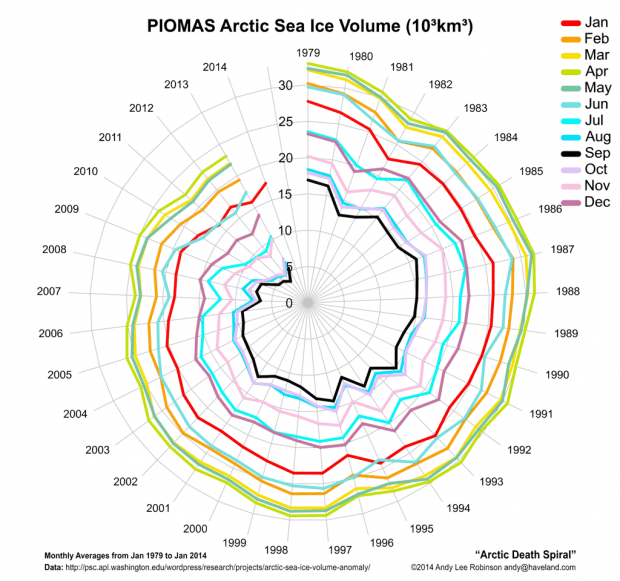
The Sound of The Arctic Ice Death Spiral

Much of the Arctic Ocean is covered by sea ice which varies in extent and thickness seasonally. The Arctic sea ice extent has been shrinking (during the summer) and growing (during the winter) over decades (achieving the maximum in April and the minimum in September). However a sea ice loss has been observed in recent decades. For example the average ice extent for March 2014 was the fifth lowest for the month in the satellite record which supports the idea of sea ice decline.

Monthly March ice extent for 1979 to 2014 shows a decline of 2.6% per decade relative to the 1981 to 2010 average. Credit: National Snow and Ice Data Center

In 2012, Peter Wadhams published a paper talking about how fast sea ice decline is happening:

Arctic sea ice extent had been shrinking at a relatively modest rate of 3-4% per decade (annually averaged) but after 1996 this speeded up to 10% per decade and in summer 2007 there was a massive collapse of ice extent to a new record minimum of only 4.1 million km2. Thickness has been falling at a more rapid rate (43% in the 25 years from the early 1970s to late 1990s) with a specially rapid loss of mass from pressure ridges. The summer 2007 event may have arisen from an interaction between the long-term retreat and more rapid thinning rates.

But what is exactly the Arctic ice death spiral?   Continue reading

Can We Hear The Sound of Our Warming Planet?

Does it sound weird for you? Great you are not alone. I had the same reaction but guys from University of Minnesota combined music and environmental data.

It is not new that our planer is warming.  Ok, lets stand on the shoulders of giants (I hate when someone uses those quotes and I don’t know where it came from). In 2010 J. Hansen and his fellows scientific friends published an article at Reviews of Geophysics. They used the Goddard Institute for  Space Studies (GISS) (NASA) analysis of global surface temperature change. Yes, there are different groups of scientists doing different analysis of global temperatures. So when you hear someone saying: “scientists said that average global temperature is rising”, it is a specific group using some specific data (not always they work together). However these analysis are not totally independent because they must use much the same information (same satellites,  meteorological stations, etc). Roughly speaking, they complete each other. Continue reading

Could climate change increase the price of airfare tickets (consequently tour costs)?

It is really funny how the things work on internet nowadays. You start looking for something and you end reading unexpected things. I was writing and reading about what is turbulence and how to avoid it (last two posts) when I found a recent (2013) interesting paper talking about the possible intensification of turbulence activity due climate change.

The paper is quite interesting. They define turbulence in an elegant way:

…turbulence when they encounter vertical airflow that varies on horizontal length scales greater than, but roughly equal to, the size of the plane.

The Australian Transport Safety Bureau (ATSB), suggested that cases of turbulence had risen and incidents doubled over the three-month period between October and December last year, compared to the previous quarter. Also moderate-or-greater upper-level turbulence has been found to increase over the period 1994–2005 in pilot reports in the United States. Continue reading

More about turbulence

Turbulence it is the most common cause of injury to air passengers, however it is not “dangerous” (it very is unlikely that an aircraft will fall because of it). It is caused by different aspects of the weather and the most common type experienced by aircraft is the Clear Air Turbulence (CAT). CAT is the turbulent movement of air masses in the absence of any visual cues such as clouds.

The science behind turbulence

This video gives an example of why turbulence happens. However they don’t mention that airplanes are equipped with sensors to give a warning in case they detect turbulence.